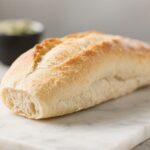
Light Airy Sourdough Ciabatta - Soft, Open Crumb With Crisp Edges
Servings 8 servings
Ingredients
- Active 100% hydration sourdough starter: Bubbly and recently fed. You’ll need 150 g.
- Bread flour: 450 g for structure and chew.
- All-purpose flour: 150 g to keep the crumb tender.
- Water: 500–540 g, lukewarm (about 80–85°F / 27–29°C). Start with 500 g and add as needed.
- Fine sea salt: 12 g (about 2 teaspoons) for flavor and gluten strength.
- Olive oil (optional): 1 tablespoon for added suppleness and fragrance.
- Semolina or rice flour: For dusting the work surface and parchment.
Instructions
- Check your starter: Feed your starter 4–8 hours before mixing. It should double, smell pleasantly tangy, and pass the float test. If it doesn’t, wait or feed again.
- Mix the dough (autolyse): In a large bowl, combine bread flour, all-purpose flour, and 500 g water. Stir until no dry bits remain. Cover and rest 30–45 minutes to hydrate the flour and start gluten formation.
- Add starter and salt: Add 150 g active starter, 12 g salt, and the olive oil if using. With wet hands, pinch and fold the dough until everything is evenly combined. If the dough feels very stiff, add up to 40 g more water a little at a time.
- First rest: Cover and let sit for 30 minutes at warm room temperature (75–78°F / 24–26°C). The dough should relax and feel smoother.
- Build strength with stretch-and-folds: Perform 3–4 rounds of stretch-and-folds over 2 hours, spaced 30 minutes apart. To do this, wet your hand, grab one edge, stretch up, and fold it over. Turn the bowl and repeat 3–4 times per round. The dough will go from shaggy to elastic.
- Bulk fermentation: After the last fold, cover and let rise until puffy, jiggly, and increased by about 60–80%. This can take 2–4 hours depending on temperature. Look for bubbles along the sides and a soft, aerated feel when you jiggle the bowl.
- Cold retard (optional but recommended): For deeper flavor and easier handling, refrigerate the dough for 8–16 hours. Cover well to prevent drying. If skipping this step, proceed directly to shaping.
- Prepare for shaping: Generously dust a work surface and a piece of parchment with semolina or rice flour. Gently tip the dough onto the floured surface, trying not to deflate it.
- Divide: With a floured bench scraper, cut the dough into two equal rectangles. Handle carefully to preserve gas inside; avoid pressing down.
- Pre-shape: Lightly flour your hands. Gently stretch each piece into a rough rectangle, then fold the short ends toward the center like a letter. Turn seam-side down and rest 20 minutes. This helps the dough relax and hold shape.
- Final shape (the “slipper”): Flip each piece seam-side up, then carefully stretch into a longer rectangle, about 10–12 inches. Fold a third of the long side over the center, then the other third on top, like folding a brochure. Flip seam-side down onto the floured parchment. Don’t worry about perfect symmetry—rustic is ideal.
- Proof: Cover loosely and proof 30–60 minutes at room temperature. When ready, the dough will look slightly puffed and spring back slowly when poked with a floured finger.
- Preheat the oven: Place a baking steel or stone on the center rack. Preheat to 475°F (245°C) for at least 45 minutes. Place a cast-iron skillet or metal pan on a lower rack for steam.
- Load with steam: Slide the parchment with the loaves onto the hot stone/steel. Carefully pour a cup of hot water into the lower pan and close the door quickly to trap steam.
- Bake: Bake 12 minutes with steam. Vent the oven (remove the pan if safe or crack the door briefly), reduce to 450°F (232°C), and bake another 12–16 minutes until deep golden brown. Internal temperature should be around 208–210°F (97–99°C).
- Cool: Transfer to a rack and cool at least 45 minutes before slicing. The crumb sets as it cools; cutting too soon compresses it.